Metalbeta manufactures elastomeric bearing pads – neoprene bearing pads and strips – for precast and cast-in-place concrete, steel, masonry and timber structures. In projects they are also called neoprene pads, neoprene strips or plain (non-reinforced) elastomeric bearings. The bearing pad distributes the load evenly, allows the element to rotate and transfer horizontal displacements, protects the edges of concrete elements from spalling and compensates for unevenness of the bearing surface.
For point supports we offer neoprene bearing pads TYPE 5 (65 Sh A, up to 14 N/mm²) and TYPE 10 (70 Sh A, up to 21 N/mm²), made to project dimensions in 1–2 days. For line supports there is the LINEAR SI neoprene bearing strip (up to 150 kN/m’, standard sizes in stock), and for CLT and glulam panels and beams the TYPE TMBR strip (up to 520 kN/m’), which also reduces the transmission of structure-borne noise between floors.
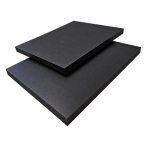
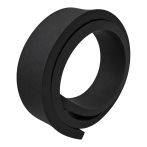
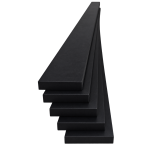
Where elastomeric bearing pads are used
A bearing pad is needed wherever two rigid structural elements must not bear directly on each other:
- supports of precast concrete beams, slabs and walls, for example on column corbels or walls (TYPE 5, TYPE 10, LINEAR SI);
- supports of cast-in-place concrete structures;
- supports of steel structures on concrete or masonry;
- supports of CLT and glulam panels and beams on steel, concrete and timber beams (TYPE TMBR);
- hybrid connections: timber–steel and timber–concrete (TYPE TMBR).
How to choose a neoprene bearing pad
The type and size of the bearing pad depend on four factors.
- Type of support. For a point support, such as a beam or slab on a corbel, choose a TYPE 5 or TYPE 10 pad. For a line support, where a slab or wall bears along its whole length, use the LINEAR SI strip. For timber structures use TYPE TMBR.
- Load. The load capacity of a plain pad depends on its shape factor, i.e. the ratio of the loaded area to the area of the free sides. That is why a thinner pad carries a higher stress. For example, a 100 × 200 mm TYPE 5 pad carries 280 kN at 10 mm thickness and 148 kN at 20 mm. The same 10 mm TYPE 10 pad carries 420 kN. If TYPE 5 is not enough, choose the harder TYPE 10.
- Rotation. A thicker pad allows a larger rotation of the supported element. For a 300 mm wide pad the permissible rotation is 15 ‰ (10 mm), 22.5 ‰ (15 mm) and 30 ‰ (20 mm).
- Edge distance. A plain pad expands under load. We therefore recommend at least 25 mm from the edge of the support to the pad, including chamfers. For TYPE TMBR – at least 15 mm.
Exact permissible loads and rotations by dimensions are given in the technical data sheet (PDF) of each product. If the project specifies a neoprene pad from another manufacturer, send us the specification and we will select an equivalent by load and dimensions.
Comparison of elastomeric bearing pads and strips
| Product | Support | Load capacity | Thicknesses | Dimensions |
|---|---|---|---|---|
| TYPE 5 | point | σR,d up to 14 N/mm² | 10, 15, 20 mm | to project, up to 1200 × 1200 mm |
| TYPE 10 | point, higher loads | σR,d up to 21 N/mm² | 10, 15, 20 mm | to project, up to 1200 × 1200 mm |
| LINEAR SI | line | Fk,max 60–150 kN/m’ | 10, 15, 20 mm | widths 20, 25, 30, 40, 50 mm (in stock) |
| TYPE TMBR | line, timber structures | Fk,max 100–520 kN/m’ | 5, 10 mm | widths 50–260 mm |
Other thicknesses are available on request. The load capacity depends on dimensions and thickness, so the table shows limit values. Specific values are given in the technical data sheets.
Plain elastomeric pad or laminated elastomeric bearing?
Plain (non-reinforced) neoprene bearing pads are suitable for most building supports: precast concrete beams, slabs and steel structures where loads and displacements are moderate. If the project requires compliance with EN 1337-3, or the support must take large horizontal displacements and loads, steel-laminated elastomeric bearings with CE marking are used – EN 1337-3 bearings (TYPE A–F).
If you are not sure which type is needed, send us the support loads, displacements and dimensions. We will propose a suitable solution.
Production, delivery and documents
- TYPE 5 and TYPE 10 pads are made to project dimensions in 1–2 days. We can make chamfers, round and rectangular holes, notches, slots, cut-outs and cut corners.
- The LINEAR SI neoprene strip in standard sizes is in stock and delivered in 1–2 days.
- We deliver across Europe.
- Each product has a technical data sheet (PDF) with permissible loads, installation instructions and tolerances.
To get a quotation, send a drawing or specification of the pads, or state the dimensions, thickness and quantity.
Frequently asked questions
What is the difference between a neoprene bearing pad, a neoprene strip and an elastomeric bearing?
Usually it is the same product: a plain (non-reinforced) elastomer pad or strip placed between two structural elements. A pad is normally used for a point support, a strip for a line support. The term elastomeric bearing more often refers to steel-laminated bearings to EN 1337-3.
What thickness of bearing pad should I choose?
A thinner pad carries a higher stress, a thicker pad allows a larger rotation. For example, for a 100 × 100 mm TYPE 5 pad the permissible design stress is 11.9 N/mm² at 10 mm thickness and 5.3 N/mm² at 20 mm. Standard thicknesses are 10, 15 and 20 mm.
What edge distance should be left?
At least 25 mm, including chamfers, because a plain pad expands under load. For the TYPE TMBR strip for timber structures – at least 15 mm.
Can a pad be made with holes or cut-outs?
Yes. We make pads with chamfers, round or rectangular holes, notches, slots, cut-outs or cut corners. The values in the data sheet tables do not account for holes, so their effect must be considered in design.
How quickly do you produce and deliver?
TYPE 5 and TYPE 10 pads are made to project dimensions in 1–2 days. The LINEAR SI strip in standard sizes is in stock and delivered in 1–2 days. We deliver across Europe.
Can you replace a neoprene pad of another manufacturer specified in the project?
Yes. Send the project specification or the pad dimensions, thickness and load, and we will select a suitable elastomeric pad or strip from our range.