Laminated and plain elastomeric bearings to EN 1337-3, CE marked – types A, B, C, D, E and F. They are used in bridges and viaducts, as well as in buildings where bearings to EN 1337-3 are required by the design; the bearings are CE marked and supplied with a declaration of performance (DoP).
TYPE A–F covers plain bearings and strips (TYPE F), bearings with a single steel plate (TYPE A), laminated bearings (TYPE B), laminated bearings with outer plates and anchors (TYPE C) and sliding bearings with PTFE and a stainless steel plate (TYPE D, and TYPE E for larger movements of ±50…±100 mm). The bearings are made to project dimensions and selected according to the design loads, movements and rotations. Where compliance with EN 1337-3 is not required, for building structures we offer our elastomeric pads TYPE 5 and TYPE 10 and the SLIDEBLOCK sliding bearings.
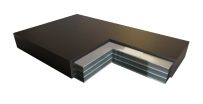
What is an elastomeric bearing
An elastomeric bearing is an elastomer block, often laminated with steel plates, placed between two structural elements. It transfers the vertical load and allows the supported element to rotate; sliding bearings also allow it to move. This avoids stress concentrations and the additional forces that a rigid support would cause.
EN 1337-3 sets out the requirements, design and testing of elastomeric bearings. Bearings to this standard are CE marked and supplied with a declaration of performance (DoP).
When bearings to EN 1337-3 are required
- Bridges and viaducts – supports of beams and decks.
- Buildings where the design specifies bearings to EN 1337-3 or CE marking is required.
- Supports that must take large horizontal movements and loads.
For most building supports with moderate loads and movements, plain elastomeric bearing pads and strips are sufficient.
Bearing types by purpose
| Type | When it is used | Fixing |
|---|---|---|
| TYPE F | plain bearing or strip for lower loads and movements | none |
| TYPE A | single steel plate – simple bearing without fixing | none |
| TYPE B | laminated bearing for higher loads; movements are taken by shear of the elastomer | none |
| TYPE C1 / C2 | laminated bearing that must be fixed to the structure | anchors through holes in the outer plates |
| TYPE D | sliding bearing: elastomer + PTFE + stainless steel plate | none |
| TYPE E1 / E2 | sliding bearing for larger movements of ±50…±100 mm (E1 multidirectional, E2 unidirectional) | fixing system and bearing plates |
The construction and materials of each type are described on the TYPE A–F page and in the technical data sheet.
How a bearing is selected
For selection and a quotation we need:
- bearing type and shape (rectangular or circular), if known;
- design vertical load (max and min) and horizontal loads;
- movements and rotations;
- quantity – or simply send the bearing schedule.
From these data we select the bearing dimensions and construction; according to EN 1337-3, deformations, steel plate stresses, stability and resistance to sliding are checked. For calculations, contact our engineering support.
Materials and documents
- Elastomer – natural rubber (NR), 60 ± 3 IRHD, shear modulus G = 0.9 MPa.
- Reinforcing plates – S235JR steel.
- Sliding bearings – PTFE layer and AISI 304L stainless steel plate.
- CE marking, declaration of performance (DoP) and technical data sheet (PDF) with specification text.
Frequently asked questions
What is the difference between a plain pad and a laminated elastomeric bearing?
A plain pad is a single layer of elastomer, so its loads and movements are limited. In a laminated bearing the elastomer layers are separated by vulcanised steel plates: the bearing carries higher loads, and movements are taken by shear of the elastomer. For buildings where EN 1337-3 is not required, plain TYPE 5 and TYPE 10 pads are usually sufficient.
Are bearings to EN 1337-3 CE marked?
Yes. The bearings are CE marked and supplied with a declaration of performance (DoP).
Can EN 1337-3 bearings be used in buildings?
Yes. They are used not only in bridges and viaducts but also in buildings where the design requires bearings to EN 1337-3 or where large movements and horizontal loads must be taken.
Which bearing is needed when the element must move?
Smaller movements are taken by shear of the elastomer in a laminated bearing. For larger movements, sliding bearings with PTFE and a stainless steel plate are used: TYPE D, and for ±50…±100 mm TYPE E1 (multidirectional) or TYPE E2 (unidirectional).
Does the bearing need to be fixed to the structure?
TYPE A, B, D and F have no mechanical fixing. Where the bearing must be fixed, TYPE C with outer plates and anchors is used, and TYPE E is installed with a fixing system and bearing plates.
Are the bearings made to project dimensions?
Yes. The dimensions of all types are selected according to the design: TYPE A and B are rectangular or circular, TYPE D circular, square or rectangular, and TYPE F is made in various sizes and thicknesses, with holes and as strips.