Sliding bearings and sliding supports (PTFE elastomeric sliding bearings) are designed for concrete and steel structures whose elements must be able to move at the support. The bearings accommodate displacements caused by temperature, shrinkage, creep and loads while reliably transferring vertical loads, so additional stresses in the structure are avoided.
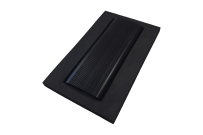
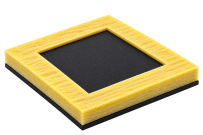
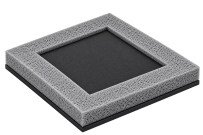
For line supports there is the SLIDELINE sliding strip (up to 300 kN/m’, displacement up to ±25 mm, friction coefficient μ = 0.15). For point supports we offer steel-plate-reinforced sliding bearings with a PTFE facing and a sliding plate, SLIDEBLOCK (σR,d = 21 N/mm²) and SLIDEBLOCK HD (σR,d = 28 N/mm²); the sliding travel is not limited, as the sliding plate is made to suit the required movement.
When is a sliding bearing needed
When an element lengthens and shortens due to temperature, concrete shrinkage, creep or loads and the support does not allow it, additional forces and cracks appear in the structure. A sliding bearing transfers the vertical load but lets the element move. Only the friction force H = μ · F is transferred to the support; other horizontal forces must be taken by separate structural measures.
Where sliding bearings are used
- SLIDELINE: supports of precast concrete beams, slabs and lintels, cast-in-place concrete supports (with a protective casing), composite and timber structures. On steel or masonry – in agreement with the manufacturer.
- SLIDEBLOCK and SLIDEBLOCK HD: supports of precast concrete beams, girders and slabs, cast-in-place concrete supports (with a protective frame) and supports of steel structures.
How to choose a sliding bearing
- Type of support. For a line support choose SLIDELINE, for a point support SLIDEBLOCK or SLIDEBLOCK HD.
- Load. The characteristic permissible load of SLIDELINE is 300 kN/m’ (5.0 N/mm², minimum 1.0 N/mm²). The design load capacity of SLIDEBLOCK is σR,d = 21 N/mm², of SLIDEBLOCK HD 28 N/mm²; FR,d = σR,d · a · b.
- Displacement. SLIDELINE allows sliding up to ±25 mm perpendicular to its axis and up to ±15 mm along it. SLIDEBLOCK displacement is unlimited: the sliding plate dimensions a1 = a + 2u and b1 = b + 2u are chosen for the required displacement u.
- Rotation. SLIDELINE – 15 ‰. SLIDEBLOCK – αmax = 1000/a ‰ for 11 and 14 mm thickness and 2000/a ‰ for 18 and 20 mm (a – pad side in the direction of rotation, mm).
- Friction and temperature. Design friction coefficient μ = 0.15 at temperatures down to −35 °C. Service temperature from −35 to +70 °C.
Comparison of sliding bearings
| Product | Support | Load capacity | Displacement | Rotation | Dimensions |
|---|---|---|---|---|---|
| SLIDELINE | line | 300 kN/m’ (5.0 N/mm²) | ±25 mm perpendicular, ±15 mm along the axis | 15 ‰ | width 60 mm, thickness 10 mm |
| SLIDEBLOCK | point | σR,d 21 N/mm² | unlimited (by sliding plate) | 1000/a–2000/a ‰ | thicknesses 11, 14, 18, 20 mm |
| SLIDEBLOCK HD | point, higher loads | σR,d 28 N/mm² | unlimited (by sliding plate) | 1000/a–2000/a ‰ | thicknesses 11, 14, 18, 20 mm |
Installation
- SLIDELINE is laid on clean, dry reinforced concrete surfaces with unevenness not exceeding ±2 mm per 1 m. Reinforcement taking the transverse tensile forces must be in place before laying.
- SLIDEBLOCK is placed so that its whole area lies within the reinforced zone. On concrete no additional fixing is usually needed. When the mean stress is below 3 N/mm², especially below −20 °C, gluing the sliding plate is recommended. On steel both parts of the bearing are fixed to the adjacent structures.
Frequently asked questions
What is the difference between a sliding bearing and a plain neoprene pad?
A plain pad takes displacement by shear deformation of the elastomer, so its displacement is limited. In a sliding bearing the element slides on a PTFE surface and only the friction force is transferred to the support.
What displacement does SLIDELINE allow?
Up to ±25 mm perpendicular to the bearing axis and up to ±15 mm along the axis.
How is the SLIDEBLOCK sliding plate sized?
The sliding plate dimensions are a1 = a + 2u and b1 = b + 2u, where u is the required displacement. That is why SLIDEBLOCK displacement is unlimited.
What is the friction coefficient of the sliding bearings?
The design friction coefficient is μ = 0.15 at temperatures down to −35 °C. Starting friction is low and the friction coefficient is constant.
Can sliding bearings be used in cast-in-place concrete?
Yes. SLIDELINE is supplied with a protective casing and SLIDEBLOCK with a protective frame.
Does SLIDEBLOCK need to be fixed?
On concrete no additional fixing is usually needed. When the stress is below 3 N/mm², especially below −20 °C, gluing the sliding plate with construction adhesive is recommended. On steel both parts are fixed to the adjacent structures.