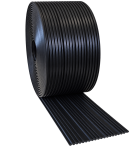
Impact sound insulation for stairs and vibration isolation that remains elastic when the element rotates. The profiled elastomeric strip TYPE W separates stair flights, landings and floor slabs from the supporting structure and reduces the transmission of impact sound to adjacent rooms in apartment buildings, offices, schools and hospitals – ΔLw = 24 dB when the characteristic compressive stress in the strip does not exceed 0.9 N/mm². In construction, such a strip for stairs is often called a neoprene strip.
The strip also acts as a structural bearing: its design bearing capacity reaches up to 17.7 N/mm², it allows the supported elements to rotate and compensates for manufacturing and installation tolerances. It is supplied in widths of 50, 100, 150 and 200 mm, 10 mm thick, in rolls of up to 10 m or cut to project specification; for cast-in-place structures – with permanent formwork. For supports of timber structures where structure-borne noise between floors must be reduced, use the TYPE TMBR strip.
Why stairs need impact sound insulation
Stair flights and landings are among the noisiest parts of a building. If they bear rigidly on walls and floors, footstep noise and vibrations travel through the structure into adjacent rooms. An elastomeric strip at the support separates the stairs from the building structure and reduces impact sound transmission.
Where impact sound insulation is used
- Supports of precast and cast-in-place stair flights and landings.
- Apartment buildings, offices, schools and hospitals.
- Supports of other precast elements where the load must be transferred while reducing vibration transmission.
- In timber structures, the TYPE TMBR strip reduces structure-borne noise between floors.
How to choose and install the strip
- Load and acoustic effect. TYPE W reduces impact sound by ΔLw = 24 dB when the characteristic compressive stress in the strip does not exceed 0.9 N/mm². Its design load capacity reaches 17.7 N/mm², so the strip also works as a structural bearing.
- Dimensions. Widths 50, 100, 150 and 200 mm, thickness 10 mm, length up to 10 m. We cut the strip to project and can drill holes and make cut-outs.
- No sound bridges. No mortar, stones or wedges may remain in the joint that would rigidly connect the stairs to the structure.
- Cast-in-place structures. For cast-in-place stairs the strip is supplied with permanent formwork that prevents concrete from entering the strip profile.
Frequently asked questions
How to insulate impact sound of a precast stair flight?
An elastomeric bearing strip such as TYPE W is installed between the stair flight and the landing or wall support. It is important that no sound bridges remain in the joint: mortar, stones or wedges.
How much does TYPE W reduce impact sound?
ΔLw = 24 dB when the characteristic compressive stress in the strip does not exceed 0.9 N/mm².
Is TYPE W suitable as a structural bearing, not only for acoustics?
Yes. The strip transfers static loads and allows elements to rotate. The design load capacity by strip width is given in the technical data sheet.
Can the strip be used in cast-in-place structures?
Yes. For cast-in-place structures the strip is supplied with permanent formwork.
Is TYPE W a neoprene strip for stairs?
Stair bearing strips are often called neoprene strips, but TYPE W is made of 70 Sh A EPDM elastomer resistant to ageing, weathering and ozone. The purpose is the same.
Do you cut the strip to project?
Yes. We cut the strip to exact dimensions and, if needed, drill holes or make cut-outs.