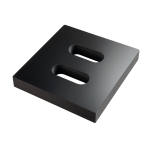
Structural thermal break pads – a load-bearing and energy-efficient solution for interrupting thermal bridges in steel and concrete connections. The load-bearing thermal insulation plate THERMO X transfers compressive loads between structural elements, interrupts thermal bridges and separates metal elements, preventing galvanic (contact) corrosion.
The plate is made of a high-strength composite: declared compressive strength fc,k ≥ 200 N/mm², thermal conductivity λ = 0.28 W/(m·K), service temperature from −40 to +100 °C. It is used in balcony slab, facade and curtain wall bracket, stair, parapet and cantilever connections, as well as in steel and reinforced concrete joints. Standard thicknesses are 10, 15 and 20 mm (up to 50 mm on request); the plates are cut to project geometry with holes, slots and chamfered edges.
What is a thermal bridge in a structural connection
A thermal bridge occurs where a load-bearing element crosses the insulation layer or connects a warm and a cold part of the structure. Steel and concrete conduct heat far better than insulation materials. Heat is therefore lost through a balcony support, a facade bracket or a steel beam, and the inner surface at the connection cools down. This increases heat loss and can cause condensation and mould.
A structural thermal break pad is placed between the connected elements. It transfers the compressive load, breaks the direct contact between metal or concrete and so reduces the heat flow paths through the connection.
Where thermal break pads are used
- Supports of precast and cast-in-place concrete structures.
- End-plate connections: steel-to-concrete and steel-to-steel.
- Facade and curtain wall bracket connections.
- Stair, balcony, parapet and cantilever connections.
- Other connections where load transfer, thermal insulation and separation of metals against galvanic corrosion are needed at the same time.
How to choose a thermal break pad
- Load. The thermal break pad transfers compression perpendicular to its surface. The declared compressive strength of THERMO X is fc,k ≥ 200 N/mm². The designer checks that the compressive stresses in the connection do not exceed the permissible values.
- Thickness. Standard thicknesses are 10, 15 and 20 mm, up to 50 mm on request. A thicker pad insulates better, but the lever arm of the bolts increases, so the bolts must be checked for bending and shear.
- Geometry. The pad must fully cover the bearing area according to the structural drawing. Holes for bolts and anchors are cut in the factory to your drawing.
- Environment. THERMO X is used at temperatures from −40 to +100 °C. It is dimensionally stable, with low creep and low water absorption.
Technical properties, installation instructions and specification text are given in the THERMO X technical data sheet (PDF).
Thermal break pad or balcony thermal break connector?
The THERMO X thermal break pad is intended for connections that transfer compression: bolted steel connections, end plates, facade brackets and supports. For cantilevered concrete balcony slabs, where bending moment and shear force must be transferred through the insulation layer, balcony thermal break connectors with reinforcement and compression elements are used. We manufacture such balcony thermal break connectors to project.
If you are not sure which solution is needed, send us the connection drawing and loads – we will propose a suitable solution.
Production and documents
- We cut the plates to project geometry with holes, slots and cut-outs.
- Standard thicknesses are 10, 15 and 20 mm, up to 50 mm on request.
- The technical data sheet (PDF) contains properties, installation instructions and specification text for designers.
- We deliver across Europe.
To get a quotation, send a drawing of the plates or state the dimensions, thickness and quantity.
Frequently asked questions
What is a structural thermal break pad?
It is a load-bearing thermal insulation plate placed between structural elements. It transfers compressive load while interrupting the thermal bridge and separating metals.
What thickness of thermal break pad should I choose?
Standard thicknesses are 10, 15 and 20 mm, up to 50 mm on request. A thicker pad insulates better, but in a bolted connection the bolts must be checked for bending and shear.
Is THERMO X suitable for steel-to-steel connections?
Yes. The plate is used in end-plate connections both steel-to-steel and steel-to-concrete.
Does a thermal break pad prevent galvanic corrosion?
Yes. The plate prevents direct metal-to-metal contact, so galvanic (contact) corrosion is avoided.
What is the service temperature of THERMO X?
The service temperature is from −40 to +100 °C.
Do you cut the pads to drawing?
Yes. We cut the plates to project geometry with bolt holes, slots and cut-outs.